















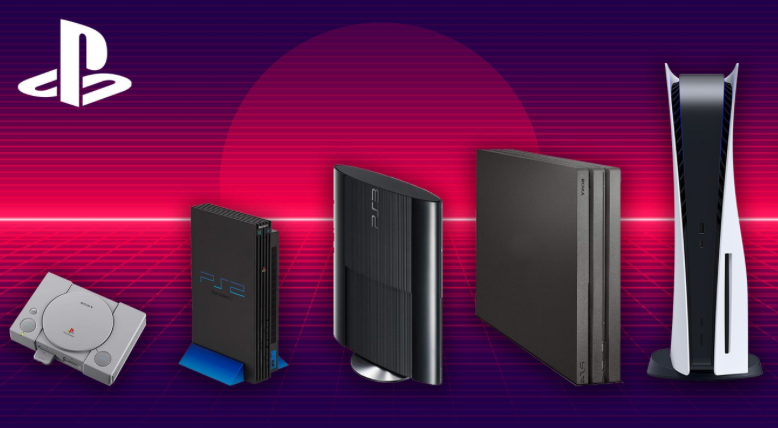
PlayStation history: Ezyplugion.com – Since its debut in the mid-1990s, Sony’s PlayStation has completely transformed the landscape of home entertainment. What started as a failed partnership with Nintendo evolved into the most recognizable brand in the video game industry.
Whether you are a nostalgic retro gamer or a cutting-edge next-gen enthusiast, understanding the evolution of the PlayStation console is a fascinating look into the rapid advancement of technology. Let’s explore how Sony changed gaming forever, along with some essential tips for today’s PlayStation owners.
PlayStation History: The Dawn of a New Era: PlayStation 1 (1994)
The original PlayStation (PS1) disrupted a market dominated by Sega and Nintendo. Its biggest technological leap was the use of CD-ROMs instead of cartridges.
- The Tech Advantage: CDs allowed for vastly superior audio, full-motion video (FMV) cutscenes, and much larger 3D game worlds (think Final Fantasy VII and Metal Gear Solid).
- The Controller Revolution: Sony later introduced the DualShock controller, featuring two analog sticks and built-in vibration, setting the industry standard for gamepads.
PlayStation History: The Unbeatable Champion: PlayStation 2 (2000)
The PlayStation 2 remains the best-selling video game console of all time, with over 155 million units sold worldwide.
- The Trojan Horse: The PS2’s secret weapon wasn’t just its superior “Emotion Engine” graphics processor; it was the built-in DVD player. For many families, the PS2 was their very first DVD player, making it a central entertainment hub.
- Online Gaming: It also laid the early groundwork for online console gaming with the Network Adapter.
The Multimedia Powerhouse: PlayStation 3 (2006)
The PS3 had a rocky launch due to its high price and complex Cell Broadband Engine architecture, but it ultimately became a technological marvel.
- Blu-ray Integration: Just as the PS2 drove DVD adoption, the PS3 pioneered the Blu-ray disc format, offering stunning High-Definition (HD) visuals.
- PlayStation Network (PSN): This era formalized Sony’s online ecosystem, introducing the PlayStation Store and free online multiplayer.
The Gamers’ Choice: PlayStation 4 (2013)
Learning from the PS3’s difficult architecture, Sony built the PS4 with PC-like components, making it incredibly developer-friendly.
- Social Gaming: The introduction of the “Share” button on the DualShock 4 controller revolutionized how gamers interact, making it effortless to capture screenshots and stream gameplay to Twitch or YouTube.
- Virtual Reality: Sony also introduced PlayStation VR (PS VR), bringing high-quality virtual reality experiences to the living room.
The Next Generation: PlayStation 5 (2020 – Present)
The current generation, the PS5, represents a massive leap in processing power, speed, and immersion.
- Lightning-Fast SSD: The custom solid-state drive (SSD) practically eliminated load times, allowing developers to create massive, seamless worlds.
- DualSense Controller: The new controller features haptic feedback and adaptive triggers, providing physical sensations that match the on-screen action (like the tension of drawing a bowstring).
Essential Tech Tips for Modern PlayStation Gamers
To get the most out of your current PlayStation setup, here are a few SEO-friendly tech tips:
- Upgrade Your PS5 Storage: The base PS5 storage fills up quickly. You can easily install an M.2 NVMe SSD to double or triple your space. Just ensure it meets Sony’s speed requirements (PCIe Gen4) and has a heatsink!
- Master PlayStation Remote Play: Did you know you don’t need to be in front of your TV to play? Download the PS Remote Play app on your smartphone, tablet, or PC, link your controller via Bluetooth, and stream your games over your home Wi-Fi network.
- Optimize Your TV Settings: To experience the true power of the PS5, make sure your TV is set to “Game Mode” to reduce input lag. If your TV supports it, enable VRR (Variable Refresh Rate) and 120Hz output in your PS5 screen settings for the smoothest gameplay possible.
Conclusion
From the blocky polygons of the original PS1 to the near-photorealistic, ray-traced worlds of the PS5, the evolution of PlayStation is a testament to technological innovation. By staying up-to-date with the latest hardware capabilities and utilizing features like Remote Play and SSD upgrades, you can ensure your gaming experience remains top-tier.