














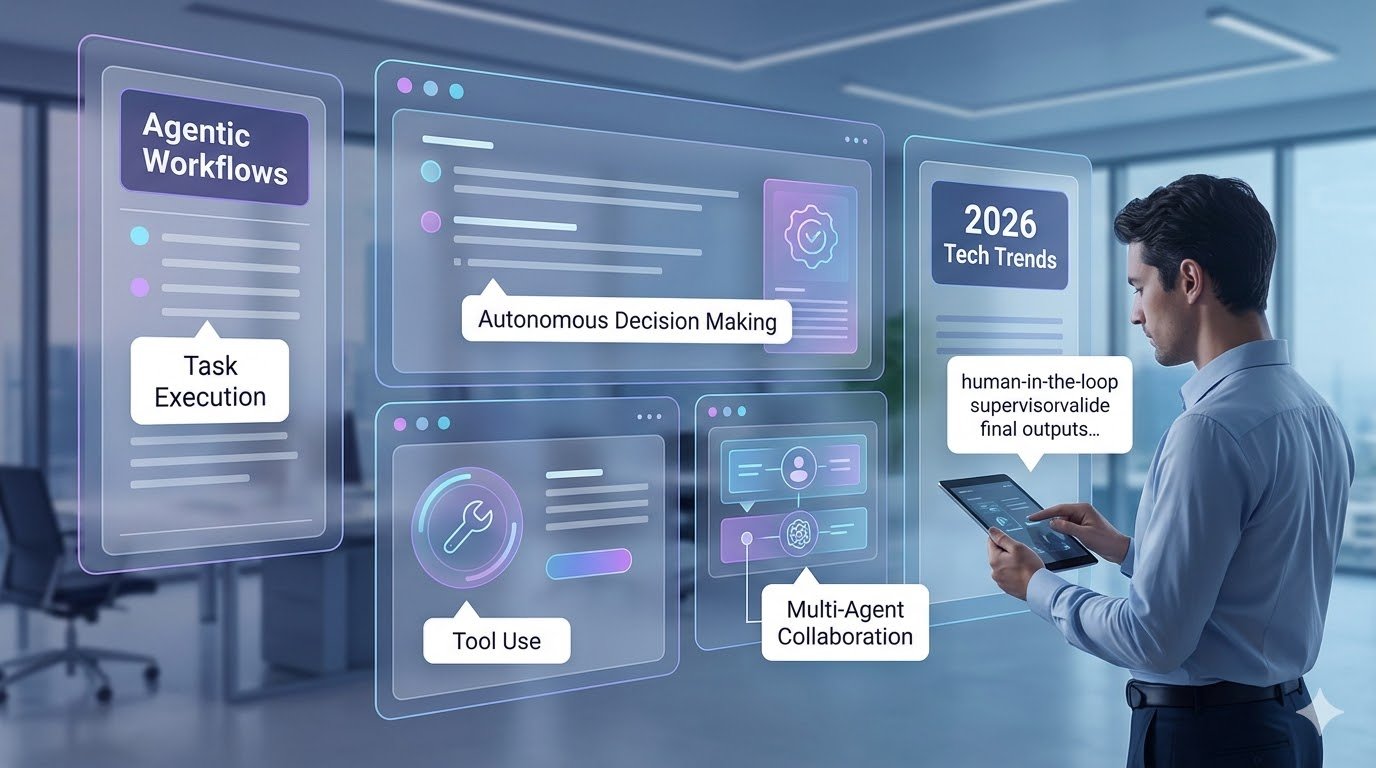
Agentic AI workflows are transforming the technological landscape in 2026. For years, our interaction with Artificial Intelligence has followed a predictable pattern, but now we are moving beyond simple chatbots.
For years, our interaction with Artificial Intelligence in the United States has followed a predictable pattern: we ask, and it answers. We generate a generic image, edit a piece of code, or summarize a long document. We called this the age of generative chatbots. But as we move into 2026, a profound shift is occurring in the American tech landscape.
We are moving from “Passive AI” to “Active AI.” The defining technology of this year is not a smarter chatbot, but the proliferation of Agentic AI workflows.
This transition represents the most significant leap in business productivity since the cloud revolution. Agentic workflows don’t just understand what you want; they possess the autonomy, tool access, and reasoning capabilities to execute complex, multi-step tasks without constant human oversight. If 2023 was the year of the LLM prompt, 2026 is the year of the autonomous agent.
The Power of Agentic AI Workflows in 2026
What Exactly is Agentic AI?
To understand the shift, we must define the core concept. A standard chatbot (like those pervasive in 2024) is a linear processor: Input $\to$ LLM Processing $\to$ Output.
An Agentic AI workflow, by contrast, is a dynamic loop. An “agent” is an AI model (often a specialized Small Language Model or a fine-tuned LLM) augmented with specific capabilities:
- Reasoning & Planning: The agent breaks down a high-level goal (e.g., “Plan a marketing campaign”) into smaller, actionable steps.
- Tool Use (Function Calling): The agent can browse the live web, access APIs, query databases, run code, and use software platforms (like CRM or project management tools).
- Memory: The agent maintains a state, remembering past interactions and data collected across the entire workflow.
- Autonomous Execution: The agent executes the plan, iterates based on feedback from its tools, and only involves a human for final approval or complex ethical decisions.
This is not just one AI model; it is an architecture.
The Catalyst for 2026: The Shift from “Ask” to “Do”
Why is this happening now, particularly in the USA? Several factors have converged in 2026 to make agentic workflows the enterprise standard.
1. The Maturity of Multi-Agent Systems
We discovered that a single, massive model isn’t efficient for complex enterprise tasks. Instead, 2026 is the era of Multi-Agent Systems. Businesses are deploying teams of specialized agents: one agent browses the web for data, a second agent synthesizes that data into a report, and a third agent format the report into a slide deck. Platforms that orchestrate these multi-agent collaborations are experiencing explosive growth in the US tech sector.
2. Standardized Tool Access
In 2024, giving an AI access to a private company database was a major security engineering challenge. In 2026, standardized secure protocols and “AI-native” APIs are ubiquitous. An agent can now securely authenticate and interact with enterprise software (Socio-technical interoperability) just as a human employee would, making autonomous task execution seamless.
3. The Enterprise Productivity Mandate
American companies are facing intense pressure to optimize. The incremental gains from chatbot summarization have already been realized. To achieve the next 10x leap in efficiency, automation must move from simple triggers (like Zapier) to intelligent, adaptive workflows. Agentic AI provides this leap, handling the “middleware” work that previously required extensive human coordination.
Real-World Examples of Agentic Workflows in Action
Agentic AI is redefining productivity across various US industries:
Specialized Software Development
For a WordPress programmer, a passive AI might help debug a specific function. An agentic workflow, however, can receive a high-level requirement—“Build a custom plugin that integrates this specific API with WooCommerce”—and proceed to:
- Reason through the required WordPress hooks.
- Generate the complete file structure.
- Write the PHP, JS, and CSS code.
- Run a local Lando environment to test the plugin.
- Present the working plugin to the human developer for final review.
Autonomous Marketing Orchestration
A marketing manager asks the system to “increase engagement for Product X on LinkedIn.” An agentic system doesn’t just suggest posts. It launches an autonomous loop:
- Analyzes competitors’ top-performing LinkedIn content (web browsing agent).
- Creates five diverse image/text content variations (creative agent).
- Simulates post performance against historical data (analytics agent).
- Schedules the optimized posts (tool-use agent).
- Monitors real-time engagement and self-corrects the next round of content creation.
The Human-in-the-Loop: Redefining Our Role
A critical component of agentic workflows in 2026 is the Human-in-the-Loop (HITL) architecture. We are not abdicating control; we are elevating it.
While agents handle the autonomous execution, humans shift to a “Supervisor” or “Architect” role. The workflow is designed to pause and solicit human judgment when:
- Confidence levels drop below a certain threshold.
- The action requires an ethical judgment call.
- The output involves a significant financial commitment.
This partnership maximizes efficiency while retaining human oversight and accountability.
Summary: Preparing for the Agentic Future
The transition to Agentic AI workflows is the defining technology trend of 2026 in the United States. Businesses that continue to rely solely on passive chatbots will be outpaced by competitors who deploy autonomous, tool-using agentic systems.
For developers, marketers, and business leaders, the mandate is clear: Stop asking what AI can tell you, and start defining what AI can do for you. The future is no longer about the chat interface; it is about the intelligent orchestration of action.